Central Taiwan Temples
Explore representative temples in Central Taiwan, including main deities, history, and cultural features.

Dajia Zhenlan Temple
Every third lunar month, a single Mazu palanquin sets off on foot with hundreds of thousands of people behind it: nine days and eight nights, more than 300 kilometers through Taichung, Changhua, Yunlin, and Chiayi. This is Dajia Zhenlan Temple's Dajia Mazu Pilgrimage. Zhenlan Temple, in Dajia District, Taichung City, is dedicated to Mazu (the Heavenly Holy Mother). It is the best-known Mazu temple in Taiwan and a heartland of Taiwanese Mazu devotion. In the basement beneath its glittering halls sits the 'Golden Mazu,' a 276-kilogram figure cast from gold medallions that worshippers offered in thanks for answered prayers, and the temple's greatest treasure. If you want to feel the almost feverish devotion Taiwanese people have for Mazu, this is the place to start.

Beigang Chaotian Temple
Say 'Beigang Mazu' and a thousand Mazu temples across Taiwan prick up their ears. Beigang Chaotian Temple, in Beigang Township, Yunlin County, is a heartland of Mazu devotion in Taiwan and the 'ancestral temple' that many other Mazu temples return to on pilgrimage. Its standing is so high that it is listed as a national historic monument. Dedicated to Mazu (the Heavenly Holy Mother), Chaotian Temple has branch temples all over the world. Every third lunar month, around Mazu's birthday, pilgrim groups from everywhere flood into this small town, with drums and gongs thundering and incense smoke curling through the air: 'Mazu fever' at its most intense. Inside, the stone carvings and cut-porcelain work preserve some superb Qing dynasty architectural art.

Lugang Tianhou Temple
There is only one in all of Taiwan. Lugang Tianhou Temple, in Lugang Township, Changhua County, enshrines the founding Holy Mother statue from the Meizhou ancestral temple, and that is what it is proudest of. Dedicated to Mazu (the Heavenly Holy Mother), the temple's Mazu statue has been darkened to a glossy black by long years of incense smoke, so people affectionately call her 'Black-Faced Mazu.' The temple is grand and imposing, its wood and stone carvings the work of master craftsmen, and the 'bagua caisson ceiling' over the main hall is a treasure of Taiwanese craftsmanship. Step inside and you step into the faded glory captured in the old saying 'first Tainan, second Lugang, third Monga.' Every New Year, worshippers rush to light 'bright lamps' and perform the 'an tai sui' rite, and spots are often hard to get.

Baishatun Gongtian Temple
No one knows which way Mazu will go today, and that is exactly what makes Baishatun Gongtian Temple so captivating. This temple in Tongxiao Township, Miaoli County, is dedicated to a 'soft-bodied' Mazu (the Heavenly Holy Mother) and is one of the Mazu temples in Taiwan with the most personality. Its annual walking pilgrimage to Beigang Chaotian Temple has 'no fixed route': the direction is left entirely to the improvised guidance of Mazu's palanquin, nicknamed the 'Pink Supercar,' so the whole journey is full of mystery and surprise. The procession moves fast and urgently, and it often turns into schools, hospitals, or private homes to bless the people inside, scattering Mazu's warmth and compassion into ordinary households all along the way.

Changhua Nanyao Temple
A Mazu temple that blends Japanese, Greek, and Baroque styles: that is the most striking sight at Changhua Nanyao Temple in Changhua City. Dedicated to Mazu (the Heavenly Holy Mother) and popularly known as 'Changhua Mazu,' Nanyao Temple has a main hall in the traditional southern Fujian style, while its rear hall, the Guanyin Hall, is strongly shaped by Western architecture. Such an East-meets-West mix is extremely rare among Taiwanese temples, and its artistic value is exceptional. Nanyao Temple also has ten Mazu associations, and its annual Bengang pilgrimage has a long history, preserving old rites such as the 'changing of the dragon robe.' It is a living fossil of Taiwan's pilgrimage culture.

Taichung Lecheng Temple
The longest Mazu procession in Taiwan happens here: the Hanxi Mazu procession through eighteen villages lasts a full 22 days. Taichung Lecheng Temple, popularly called the 'Hanxi Mazu Temple,' stands in Taichung's East District. It was once one of Taichung's four great Mazu temples, is listed as a municipal historic site, and is dedicated to Mazu (the Heavenly Holy Mother). Its rebuilding was led by the master craftsman Chen Yingbin, and its wood and stone carvings are exquisite. Beyond Mazu's reputation for answering prayers, the temple's Yuelao Hall, devoted to the Old Man Under the Moon, is famous across Taiwan and hailed as 'the most efficacious Yuelao in central Taiwan.' Every year countless single people come to pray for a match, and it has brought together countless happy couples. Pray to Mazu and ask for a good match: here you can do both.

Zhushan Zinan Temple
Borrow NT$600 from the Earth God: that is what Zhushan Zinan Temple is best known for. This temple in Zhushan Township, Nantou County, is dedicated to Tudigong, the Earth God, and is famous across Taiwan for 'borrowing fortune money.' Worshippers borrow 600 from the Earth God as 'mother money' and tuck it into their wallets so their money will keep multiplying. If they have made a profit by the following year, they return the principal and add whatever incense donation they wish. Every Lunar New Year, crowds line up to borrow fortune money. The temple also built a public restroom called 'Golden Bamboo Shoot Welcomes Guests,' which has unexpectedly become an attraction in its own right.

Songboling Shoutian Temple
Stand on Songboling at the southern end of the Bagua Mountains and the plain below opens up before you: this is the 'Distant View from Songling' that belongs to Songboling Shoutian Temple alone. Located in Mingjian Township, Nantou County, Shoutian Temple is dedicated to Xuantian Shangdi (the Supreme Emperor of the Dark Heaven) and is one of the head ancestral temples of his worship in Taiwan. More than 18,000 temples and shrines have taken incense from it, and its incense burns exceptionally strong. Every year around Xuantian Shangdi's birthday on the third day of the third lunar month, pilgrim groups from all over Taiwan arrive in an endless stream, with lively, colorful troupe performances: one of the great events of Taiwan's religious calendar. A climb with a sweeping view and a visit to an ancestral temple in one trip make it well worth the journey.

Beigang Wude Palace
When business people want to pray for wealth, they come here. Beigang Wude Palace, in Beigang Township, Yunlin County, is the founding ancestral temple of Taiwan's Five Directions Gods of Wealth and the largest of its kind in Taiwan. Dedicated to Zhao Gongming, the heavenly-official Martial God of Wealth, Wude Palace is a majestic complex with a 'Heavenly Treasury' furnace several stories tall, billed as the largest in the world, built for worshippers to burn 'treasury money' that replenishes their fortune. It is a must-visit for business owners and merchants, its incense burns extraordinarily strong, and the 'mother money' it hands out every New Year is very popular. Pray for wealth, top up your fortune, and collect your mother money, all in one stop.

Taichung Fahua Temple
Taichung Fahua Temple, in Taichung's West District, is dedicated to Shakyamuni Buddha. It began as a mission station set up by the Nichiren school during the Japanese colonial era and was only renamed Fahua Temple after the war; its current six-story building was completed in 1996. The grounds are quiet and peaceful, a place in the middle of the busy city where you can let your mind settle.
Shanbian Mazu Temple
A Mazu who for decades had no temple of her own: that is the moving devotion of Shanbian Mazu in Houlong Township, Miaoli County. Shanbian Mazu (the Heavenly Holy Mother) long kept the unusual tradition of 'a deity without a temple,' cared for in turn in the home of each year's appointed incense-burner host. Only in 2013 was she enthroned in a temporary temple, and a larger temple is now being planned. Shanbian Mazu and Baishatun Mazu are as close as sisters: since 1953 they have insisted on sharing a single palanquin on the pilgrimage to Beigang, and she is an indispensable part of the procession. Her palanquin is light and nimble, and often surprises the crowd with astonishing moves.

Xiangtianhu Pasta'ay Ceremonial Ground
The lake drifts in and out of the morning mist, and all night long a mournful, ancient ritual song echoes along its shore. This is Xiangtianhu (Lake Facing Heaven), in a mountain basin about 738 meters above sea level: the ceremonial ground of the southern group of the Saisiyat people's Pasta'ay, the Ritual of the Short Spirits (the northern group's ground is in Wufeng, Hsinchu), and the most mysterious and moving indigenous ceremonial site in Taiwan. Ringed by mountains, the scenery feels like a dream. The Pasta'ay is held as a minor ritual every two years and a grand ritual every ten. It lasts four days and three nights and runs through the night by the lake, with solemn songs and slow dance steps offering repentance, thanks, and prayers to the spirits of the ancient short people. The ritual was designated an Important Folk Custom of Taiwan in 2013, and beside the ceremonial ground stands the Saisiyat Folklore Museum, opened in 2004.
 Illustration
Zhunan Wugu Temple
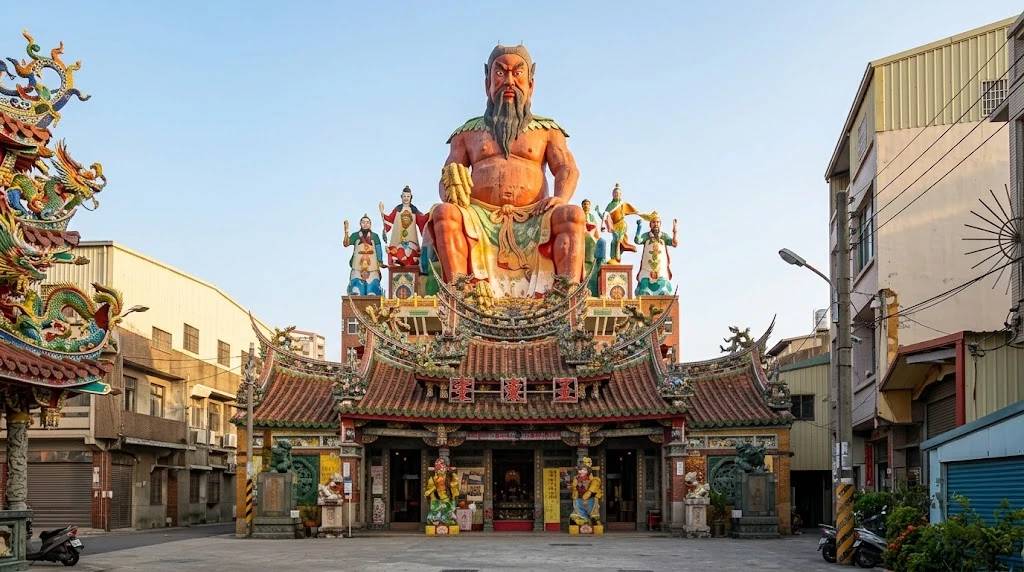
Ride the train through Zhunan, glance out the window, and a 46.8-meter statue of Shennong, the Divine Farmer, suddenly appears. That is Wugu Temple. Completed in 1998, the giant statue has become the most recognizable landmark in all of Zhunan: you do not need to check the timetable, because when you see him, you know you have arrived. Its full name is the Zhunan-Toufen-Zaoqiao Wugu Temple, and it is dedicated to Shennong, the Emperor of the Five Grains, worshipped jointly by the Hoklo and Hakka communities of Zhunan, Toufen, and Zaoqiao. In an era of sharp ethnic boundaries, this kind of shared Hoklo-Hakka worship was quite rare. Shennong watches over farming and medicine, and for more than two hundred years, people here have always come to tell him first how the harvest is going.
 Illustration
Lugu Fenghuangshan Temple
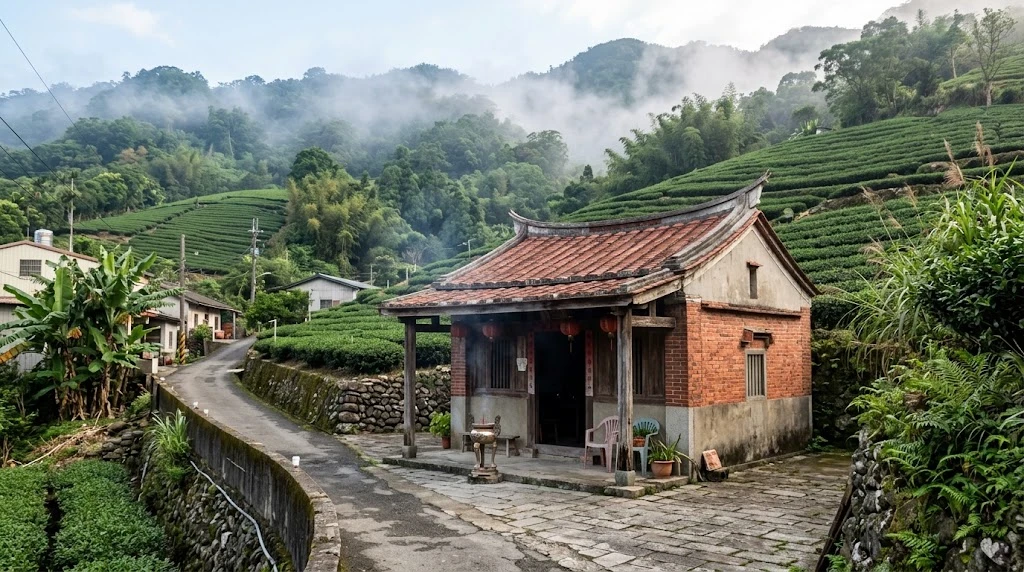
The god worshipped here carries the word "shame" in his name — you'd be hard pressed to find another god in Taiwan named after his own regrets. Cankui Zushi, born Pan Liaoquan, attained the Way through practice on Yinna Mountain in Guangdong. Before he died, feeling he had not managed to bring all beings across to freedom from suffering, he told his disciples to carve the words "cankui" — shame — on his stupa. Lugu Fenghuangshan Temple, built in the Jiaqing era, is the heart of Cankui Zushi worship in the Nantou mountains. For the Han settlers who came into these hills to clear land, he was the most practical of gods: malaria, wild beasts, getting lost in the mountains — he was the one they prayed to. The temple sits down a lane in Fenghuang Village, the altitude bringing a cool edge to the air, so quiet you can hear the wind from across the tea gardens.