North Taiwan Temples
Explore representative temples in Northern Taiwan, including main deities, history, and cultural features.

Manka Longshan Temple
In the front hall (the Sanchuan Hall) of Manka Longshan Temple stands a pair of cast-bronze dragon pillars, the first bronze dragon pillars ever used in Taiwan, installed during the 1919 rebuilding. This is one of the oldest temples in Taipei's Wanhua District, and even the columns holding up its roof have a story. Walk through the three halls, laid out around courtyards like the character 回, and look up: the caisson ceiling is carved in a spiral, ring after ring narrowing upward in astonishing detail. Longshan Temple is dedicated first to Guanyin Bodhisattva, but its rear and side halls house more than a hundred other deities, among them Mazu, Wenchang Dijun, Lord Guan (Guansheng Dijun) and Yue Lao, the Old Man Under the Moon. One temple holds the whole Taiwanese habit of praying to gods and buddhas side by side: people come for exam success, for love, for safety, each at the right altar. International visitors flock here, yet to the people of Wanhua it is simply the temple where they burn incense on the 1st and 15th of the lunar month. Stone carving, woodwork and painted decoration fill every corner, and when worship peaks the whole forecourt is packed with people.

Xingtian Temple
Xingtian Temple has never burned joss paper. In 2014 this Enzhugong temple in Taipei's Zhongshan District went further and removed the great incense burner from its forecourt, encouraging worshippers to pray with their palms pressed together instead. It is dedicated to Lord Guan (Guansheng Dijun), yet it goes against the usual temple grain: there is no donation box and no animal offerings, only a focus on sincerity of heart and honest reflection. The building is grand in scale but almost bare of elaborate carving, which only makes it feel more solemn. What people remember most are the volunteers in sky-blue robes. When their minds are unsettled or their luck is low, many come here and wait in line for these volunteers to perform shoujing, a ritual to calm a frightened spirit, hoping to leave with a little peace of body and mind.

Dalongdong Baoan Temple
A temple can win international recognition for how well it is restored, and Dalongdong Baoan Temple did exactly that. Because its restoration held to traditional craftsmanship instead of taking modern shortcuts, this old temple in Taipei's Datong District received an Honourable Mention in the UNESCO Asia-Pacific Awards for Cultural Heritage Conservation in 2003, and it has become a model for temple restoration in Taiwan. It is dedicated to Baosheng Dadi, the god of medicine. Inside, the walls carry murals by the master painter Pan Li-shui, alongside fine koji pottery and woodcarving. With less of the usual temple bustle and more of a scholarly calm, stepping in feels like entering a quiet hall of art.

Taipei Xia-Hai City God Temple
Tucked into Dihua Street in Taipei's Dadaocheng, Taipei Xia-Hai City God Temple covers only about 46 ping (a traditional Taiwanese unit of floor area), yet its incense never dies down. Its main deity is the City God who protects the neighborhood, but what really brings young people here in lines is Yue Lao, the Old Man Under the Moon. According to the temple's own count, more than 6000 couples come back each year to thank him, which has turned this small temple into a famous place to pray for love. After you pray, don't rush off: have a cup of the temple's peace tea for a wish of safety and a happy ending.

Songshan Ciyou Temple
Finish praying to Mazu, turn around, and you are at one of Taiwan's liveliest night markets. This is Songshan Ciyou Temple, popularly called the Songshan Mazu Temple, standing beside Raohe Street Night Market in Taipei's Songshan District and a classic example of Taiwan's temple-front culture. The main hall has a triple-eave roof, and the rear hall rises six stories high, glowing brilliantly once the lights come on at night. Its main deity is the black-faced Mazu, known for her compassion and answered prayers, and the temple also hosts Zhusheng Niangniang, the Tiger Lord and other deities. Light your incense, make your wish, then step straight into Raohe Night Market next door to eat your way through it. In one visit you walk through both everyday Taiwanese life and its folk faith.

Zhinan Temple
"Couples who visit Zhinan Temple together will break up." That is the most widely told urban legend about this Xiangong Temple on the slopes of Mount Zhinan in Muzha, Taipei's Wenshan District. Zhinan Temple has long been called "the most sacred mountain under heaven." It is a well-known Taoist holy site in Taiwan, and also one of the rare temples that brings Confucianism, Taoism and Buddhism together. Built into the mountainside on a grand scale, it lets you look out over the whole Taipei Basin from in front of its halls. From the Chunyang Hall honoring Lü Dongbin (Lüzu) and the Lingxiao Hall of the Jade Emperor to the Mahavira Hall and the Dacheng Hall, it gathers immortals, buddhas and sages on the same mountain. As for the breakup legend, worshippers have since turned it around: the temple is now sought out for cutting off bad romantic ties and praying for the right partner, and people who want to clear up their love lives and start over climb the mountain on purpose to pray here.

Hongludi Nanshan Fude Temple
A statue of the Earth God, 108 tai-chi tall (traditional Taiwanese feet) including its base, stands on the hilltop looking down over all of Zhonghe. This is Hongludi Nanshan Fude Temple, one of northern Taiwan's best-known places to pray for wealth and the most eye-catching landmark in New Taipei's Zhonghe District. The giant Tudigong has a kindly face and holds a gold ingot steady in his hand. The temple sits on Nanshijiao Mountain with a wide-open view, so you can take in the night lights of greater Taipei on the same trip. It is open 24 hours, and the later it gets the busier it becomes: many salespeople and business owners like to come up at night to exchange for "mother money" and touch the gold ingot, praying for their fortunes to flow.

Taipei Confucius Temple
In the Dacheng Hall of Taipei Confucius Temple, you will not find a single statue. This Confucius temple in Taipei's Datong District follows the Confucian teaching of not worshipping idols, so the hall honors Confucius, the Supreme Sage and Foremost Teacher, with spirit tablets alone. Built in the Minnan style, every brick and pillar feels upright and solemn. The best reason to make a special trip is the ceremony honoring Confucius (the Shidian rite) held every year on Teachers' Day, September 28. By custom the mayor serves as chief officiant, young performers dance the ancient yi dance, and Confucius is honored with ancient rites. It is one of Taipei's most important celebrations of Confucian culture.

Taipei Wenchang Temple
Every exam season, the walls of Taipei Wenchang Temple fill up with photocopies of exam admission tickets, layered so thickly that they become a sight in their own right. Standing beside Shuanglian MRT Station in Taipei's Zhongshan District, this is a well-known Wenchang temple in central Taipei, dedicated to Wenchang Dijun, the god in charge of scholarly success. Worshippers arrive carrying bags of punning offerings: scallions for cleverness, celery for diligence, radish (caitou) for good fortune, and zongzi rice dumplings, whose name sounds like "sure to pass." All their hopes of seeing their names on the pass list are placed in these offerings they can hold in their hands.

Songshan Fengtian Temple
At midnight as the 9th day of the first lunar month begins, Songshan Fengtian Temple is packed solid with worshippers who have come to honor Tiangong, the Lord of Heaven. It is the biggest night of the year. This Taoist temple in Taipei's Xinyi District is dedicated to Tiangong, the Jade Emperor, and is one of the most important centers of Jade Emperor worship in the Taipei area. The resplendent main hall enshrines the Jade Emperor, with the Three Officials (Sanguan Dadi) worshipped alongside him. If you want to see how Taiwanese people honor heaven with their most solemn rites, Tiangong's birthday on the 9th day of the first lunar month is the grandest lesson there is; the media call this the largest Tiangong temple in northern Taiwan.

Keelung Dianji Temple
One of Taiwan's most famous night markets grows right around a temple, and that is the remarkable sight at Keelung Dianji Temple. Located in Keelung's Ren'ai District, it is one of Keelung's three great temples and is dedicated to Kaizhang Shengwang, the Sacred King Who Opened Zhangzhou. The whole Keelung Miaokou Night Market spreads outward with the temple at its center, creating a scene where the night market sits inside the temple grounds and wraps around the temple. It is both a center of faith and a food hub known across Taiwan, with incense and crowds that never fade all year. Look up at the carved beams and painted rafters inside, too; don't spend all your time eating.

Hsinchu City God Temple
When it comes to divine rank, Hsinchu City God Temple is often called the highest-ranking City God temple in all of Taiwan. When it was elevated to the title of Duke Weiling in 1890, the sixteenth year of the Guangxu reign, it was granted a plaque reading "Jinmen Baozhang." This old temple in Hsinchu's North District draws a steady stream of worshippers, and its most powerful spectacle comes in the 7th lunar month during the Zhuqian Zhongyuan City God Festival. In the ritual of carrying the cangue to dissolve misfortune, thousands upon thousands of devotees parade through the streets wearing paper cangues in repentance, an awe-inspiring sight. After you pay your respects to the City God, don't miss the snacks around the temple square that are famous across Taiwan: meatball soup (gongwan), rice noodles and ba-wan, one stall after another. Here you can satisfy both faith and appetite in one visit.

Taoyuan Jingfu Temple
When Taoyuan locals say they are going to "the Big Temple" to pray, they mean Jingfu Temple. This municipal monument in Taoyuan District, Taoyuan City, is the most important center of faith in the whole urban area. It is dedicated to Kaizhang Shengwang, the Sacred King Who Opened Zhangzhou, and was founded jointly by fifteen villages of Zhangzhou immigrants. Jingfu Temple has a distinctive roof style, a double-eaved hip-and-gable roof with false four-sided eaves, rising tier upon tier and making the exterior especially magnificent. It stands on the roundabout in the center of Taoyuan, a spiritual landmark that Taoyuan people can see just by looking up.

Dharma Drum Mountain
Step into Dharma Drum Mountain and you'll find it looks less like the incense-wreathed temple you might picture and more like a quiet academy in the hills. Set among the green slopes of Jinshan District in New Taipei City, this Buddhist monastery is home to one of Taiwan's four major Buddhist organizations, founded by Master Sheng Yen in 1989. Its architecture deliberately blends modern lines with a Zen sensibility, echoing at every turn the Master's call for "protecting the spiritual environment." The grounds include a meditation center and a Buddhist college. If you want to set the noise of the world down for a while and learn to still your mind, Dharma Drum Mountain is the clearest expression of how Taiwanese Buddhism has modernized.

Beipu Citien Temple
Beipu Old Street begins on the stone-slab forecourt of Citien Temple. A county-designated historic site in Beipu Township, Hsinchu County, it is the most representative Hakka center of faith in the county and the landmark at the heart of the whole Beipu settlement. The temple is dedicated to Guanyin Bodhisattva, a classic example of the Hakka custom of putting Guanyin first. Its layout is two halls, two corridors, and two side wings, and its entrance hall is known for sandstone carving. The pair of stone dragon pillars along the front porch both show "ascending dragons" coiling upward on each side, a treatment rarely seen in Taiwanese temples. Inside are two sets of stone columns carved with the Twenty-Four Filial Exemplars, finely worked and just as rare in Taiwan. On weekends, walk from the forecourt into the old street and you'll be carried along by a steady stream of visitors.

Baozhong Yimin Temple
Most temples worship a statue. Baozhong Yimin Temple worships a grave, and that is what makes it so unusual and so moving. Standing in Xinpu Township, Hsinchu County, it is one of the two great centers of Yimin ("righteous volunteers") faith in Taiwan, alongside the Zhongyi Pavilion of Liudui in Pingtung, and the center of faith for Hakka communities in the north. At the heart of that faith is the Yimin Tomb behind the temple, where Hakka volunteers who died defending their homes in Qing-era uprisings such as the Lin Shuangwen Incident are buried. The plaque hanging high in the main hall reads "Baozhong," two characters bestowed by the Qianlong Emperor. Every year on the 20th day of the 7th lunar month, the Yimin Festival is hosted in rotation by fifteen major villages of the Taoyuan and Hsinchu area. Its best-known event is the divine pig competition, in which devotees vie to raise the heaviest pig as an offering, honoring their forebears in the most abundant way they can.

Xinzhuang Wu Temple
Xinzhuang Wu Temple is said to be the oldest temple to Guan Di, Lord Guan, in the Taipei Basin. This temple in Xinzhuang District, New Taipei City, is also a municipal historic site. It witnessed the days when Xinzhuang was a thriving port crowded with sails, and it still holds many precious old plaques and stone inscriptions, making it an important place for anyone tracing Xinzhuang's history.

Xinzhuang Dizang An
Those fierce, elaborately face-painted Guan Jiang Shou, the demon-quelling generals seen at Taiwanese temple festivals, have origins closely tied to Xinzhuang Dizang An. This temple in Xinzhuang District, New Taipei City, commonly known as Dazhong Temple, is dedicated to Ksitigarbha Bodhisattva (Dizang Wang) and the civil and military Dazhong Ye. When people lose something, they often come here to pray for help finding it, and the temple is one of the most important centers of faith in the Xinzhuang area. Every year on the 1st day of the 5th lunar month comes the Great Xinzhuang Festival, the Dazhong Ye procession, whose distinctive "night patrol" rite and Guan Jiang Shou troupes make it one of the most representative temple festivals in northern Taiwan. It is worth a special trip to feel that atmosphere, solemn and festive at once.
 Illustration
Xinzhuang Guangfu Temple
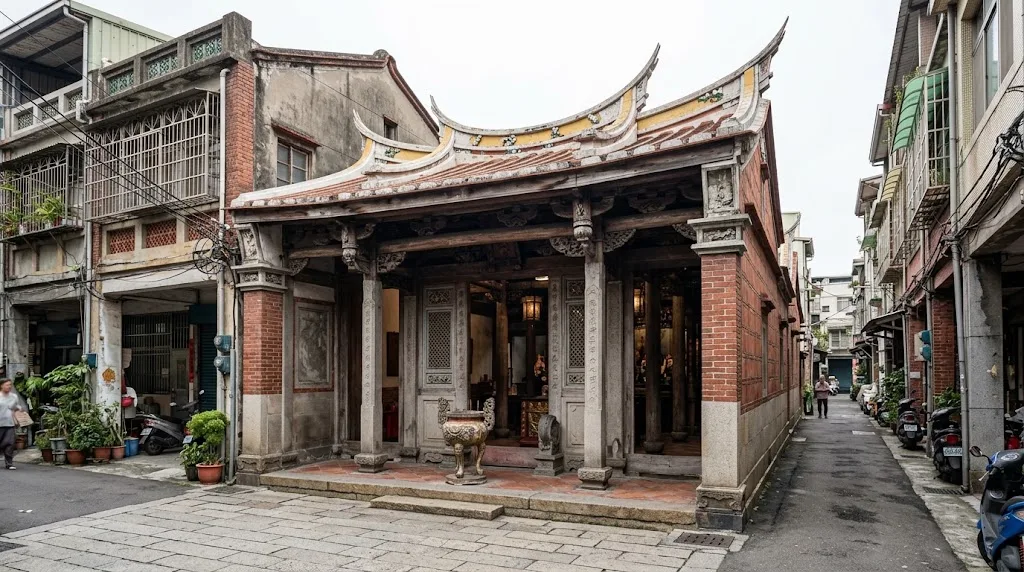
Of the four old temples on Xinzhuang's old street, the best preserved is, oddly, the one that lost its worshippers: Guangfu Temple, which locals still call the Three Mountain Kings Temple. The Three Mountain Kings are a local faith from Chaozhou in Guangdong, carried across the strait by Chaozhou settlers. When those settlers later left Xinzhuang, the temple lost its incense and its patrons — and so escaped the rounds of renovation that remade its neighbors, keeping its Qing-dynasty face. Today it is a national monument: the gate carvings are cut from Guanyin Mountain stone, the roof frame is Minnan-style yet uses rare square beams, and the front is built of red brick while the rear is dark brick. Slow down here when you walk the old street.

Hsinchu Putian Temple
Before you even reach Hsinchu Putian Temple, you'll see its giant statue of Guansheng Dijun (Lord Guan), 120 Taiwanese feet tall, about 36 meters. Grand and imposing, it comes into view from far away and is the temple's best-known landmark. Located in Hsinchu's East District, near the Hsinchu Science Park, the temple is dedicated to Guansheng Dijun. Beyond Lord Guan, Putian Temple's Yue Lao, the Old Man under the Moon who rules over matchmaking, is also well known, drawing many single men and women to pray for a good match. In a tech city that runs on efficiency, it is a place to ask for a little guidance in love.
 Illustration
Sanxia Changfu Temple
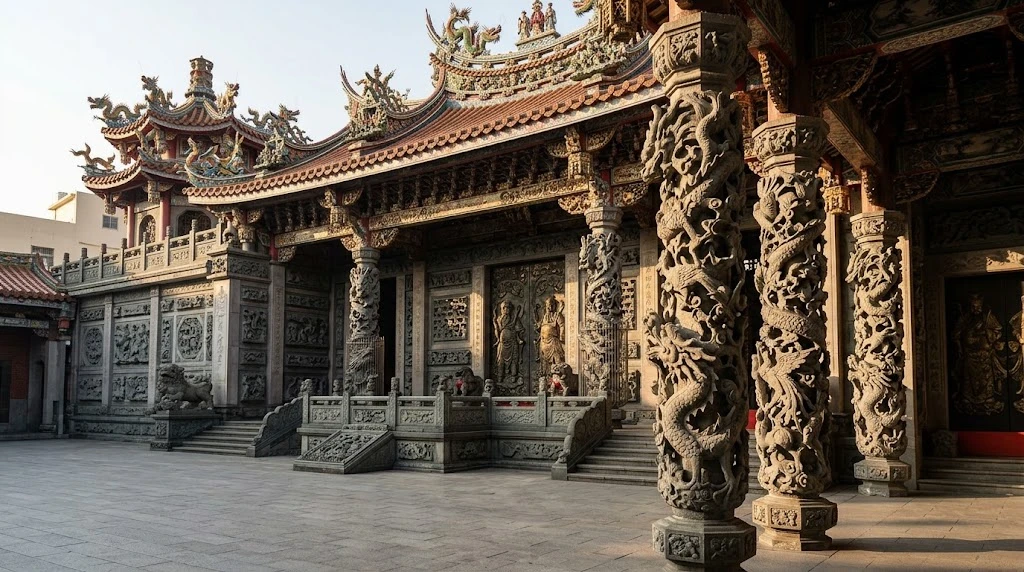
Walk into Sanxia Changfu Temple and don't look up at the statues first; look down at the pillars. The flowers, birds, and figures on every stone column were cut stroke by stroke, deep enough to slip a finger into. This temple to Qingshui Zushi has been rebuilt since 1947 under the direction of Li Mei-shu, a painter born in Sanxia, who brought his training in Western art into a traditional temple. He devoted decades to it, finishing stone, wood, and bronze carvings one piece at a time, and the work was still incomplete when he died. That is why Changfu Temple is a rare thing in Taiwan, an old temple still being built: what you see today is a relay that has run for decades. In 2018 it was designated a New Taipei City historic site.
 Illustration
Manka Qingshui Temple
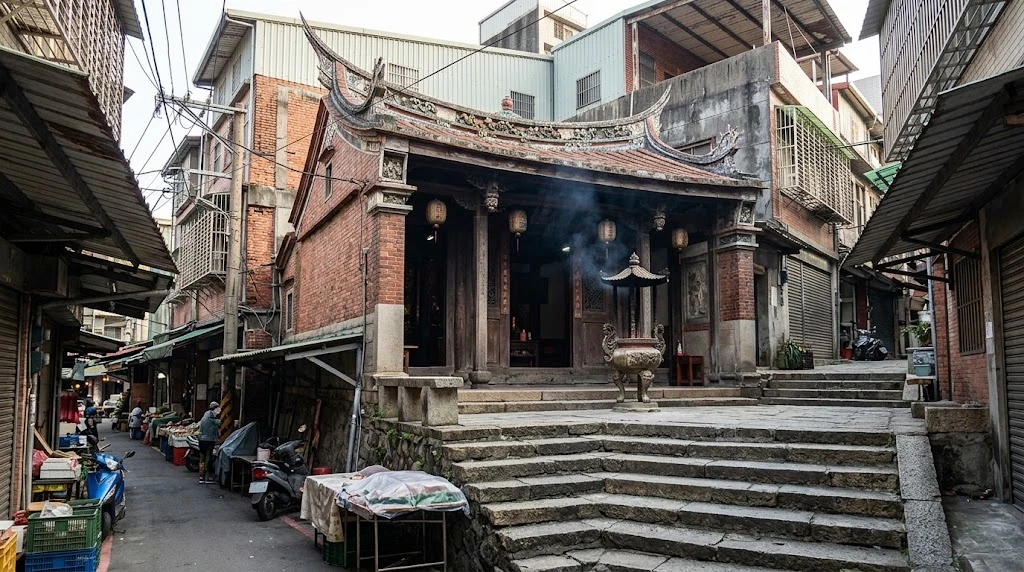
Manka Qingshui Temple is one of the few old temples in Taipei that is only half there. It once had three halls, but the rear hall burned down in a fire in 1940 and was never rebuilt, so the building simply stops, and that absence has become part of its history. Known locally as the Zushi Temple, it enshrines Qingshui Zushi and was built in 1787 with funds raised by migrants from Anxi. It ranks with Manka Longshan Temple and Dalongdong Baoan Temple as one of Taipei's "three great temples," and it is a municipal historic site. Inside it is quieter than you might expect: none of Longshan Temple's crowds, light falling in through the courtyard, dark timber soaking up half the sound. If you want somewhere in Wanhua to sit for a while, this suits better than any of the streets around it.
 Illustration
Tamsui Qingshui Temple
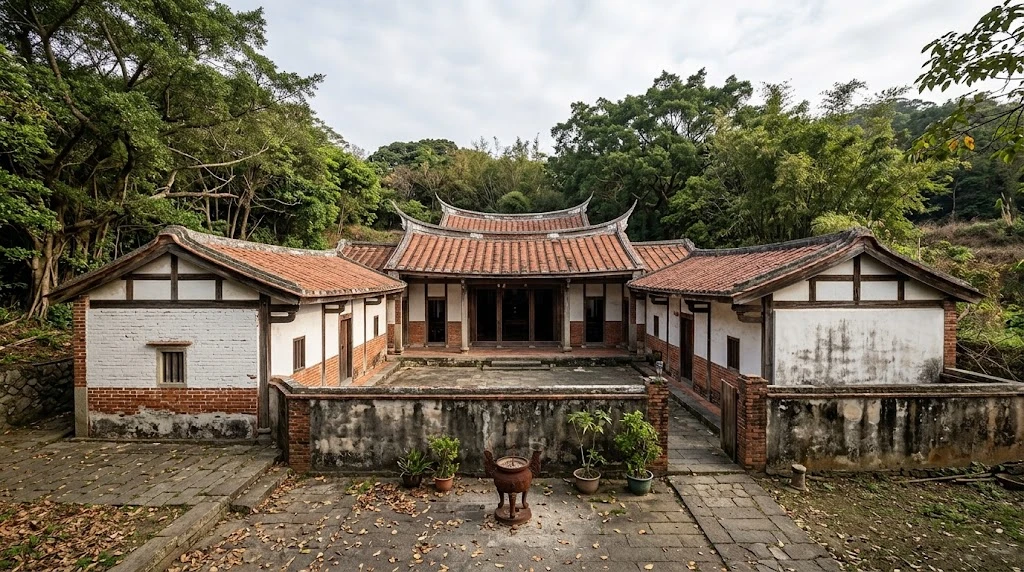
The Qingshui Zushi enshrined at Tamsui Qingshui Temple has one of the most vivid names in Taiwan: the Nose-Dropping Ancestor. Legend says that when disaster is coming, the deity's nose falls off by itself as a warning. It sounds far-fetched, but people in Tamsui tell the story in earnest, because it concerns the safety of an entire town. Built in 1937, the temple isn't especially old, yet it is one of greater Taipei's four great Zushi temples, and together with Yinshan Temple, Fuyou Temple, and Tamsui Longshan Temple it is counted among Tamsui's four great temples. It is tucked into the market lanes of Qingshui Street: turn in from the busy old street and within a few steps the crowd's noise gives way to drifting incense. Tamsui's busiest side and its stillest are only a corner apart.
 Illustration
Tamsui Yinshan Temple
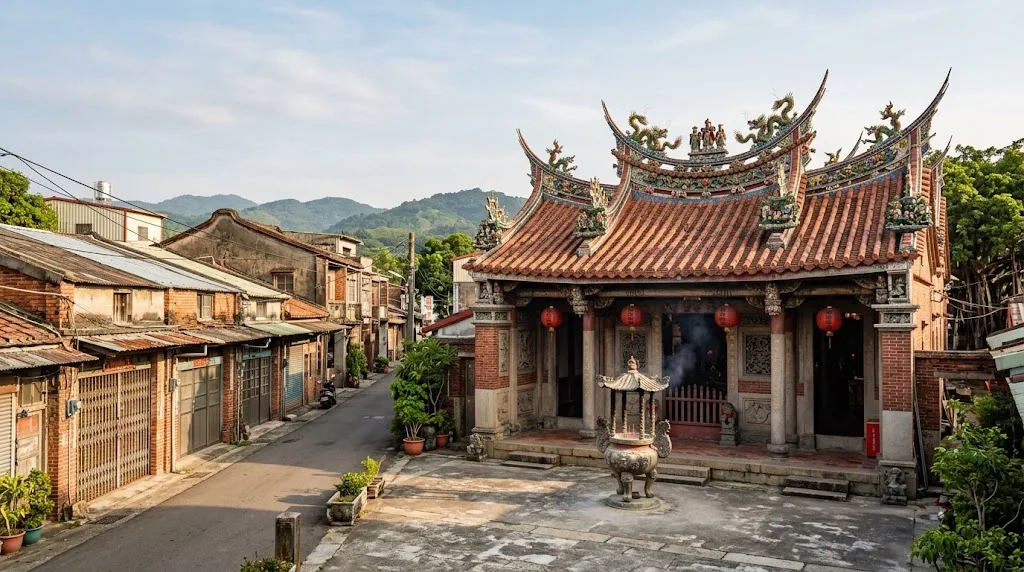
Yinshan Temple will make you rethink what a temple is: its two side wings were not built for a deity but for people to sleep in. Founded in 1822, the 2nd year of the Daoguang reign, by Hakka migrants from Tingzhou in western Fujian, it enshrines their guardian, Dingguang Gufo (the Dingguang Buddha), and its two wings were set up as the Tingzhou Guild Hall so that fellow countrymen arriving later had a place to stay as soon as they stepped off the boat. Like the Dingguang Buddha temple in Changhua, it is a Qing-era Dingguang Buddha temple that doubled as a Tingzhou guild hall. Its layout is two halls, two corridors, and two side wings, and it is now a national historic site. For those Hakka migrants, this temple was both the deity's home and their own: first they settled their faith, then they settled themselves.
 Illustration
Linkou Zhulinshan Guanyin Temple
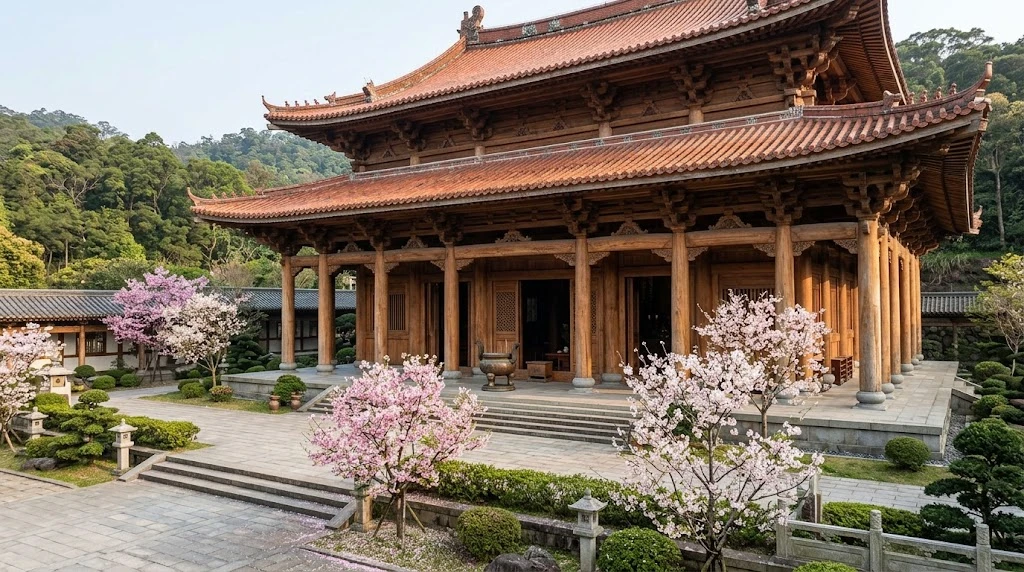
Zhulinshan Guanyin Temple's name is pieced together from three place names, Luzhu, Linkou, and Guishan, one character from each. The name says plainly what the temple is: not one village's shrine, but a center of faith that three communities raised together. It enshrines the Eighteen-Armed Guanyin, and its halls were rebuilt and completed in 2012. In front of the temple lies a garden of about 20,000 ping, with cherry blossoms in spring; on a weekday morning there is little to hear but someone sweeping. It is one of the few places on the edge of greater Taipei that manages to be both big and quiet.
 Illustration
Manka Dizang Temple
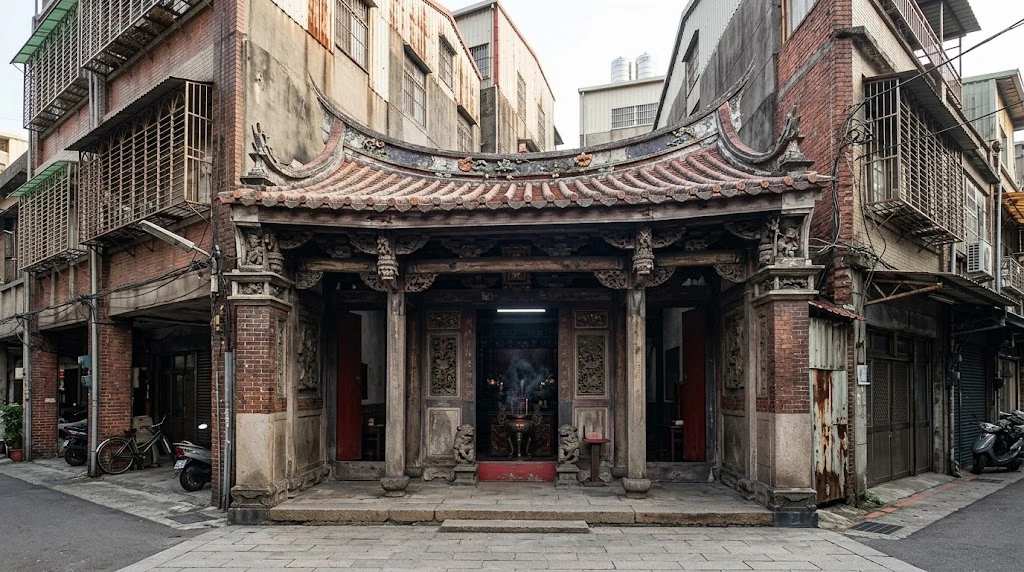
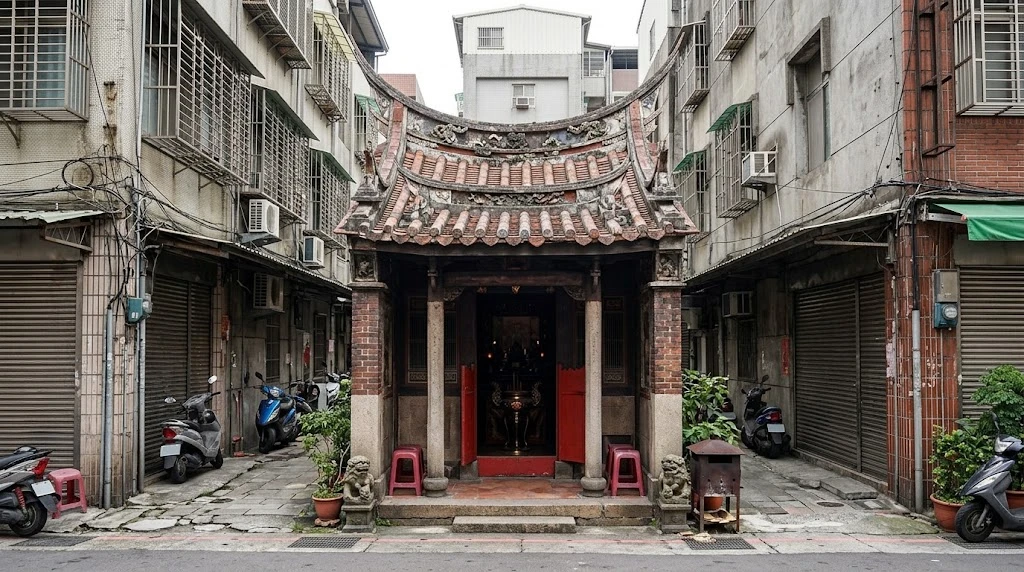
Manka Dizang Temple is small enough to walk straight past: a single hall three bays wide, squeezed between shopfronts on Xichang Street, with no archway and no forecourt. That is exactly what makes it precious. Most of Taipei's old temples have grown bigger and bigger over two centuries and more; this one has kept the original form of a mid-Qing single-hall temple. It is dedicated to Ksitigarbha Bodhisattva (Dizang Wang), with Marshal Tian Du and the City God enshrined alongside. It isn't a tourist hotspot, and most of the time there are just a few elderly neighbors sitting by the door. If you want to see a temple as it originally was rather than as renovation has remade it, this is the most direct example in Taipei.
 Illustration
Xinpu Guanghe Temple
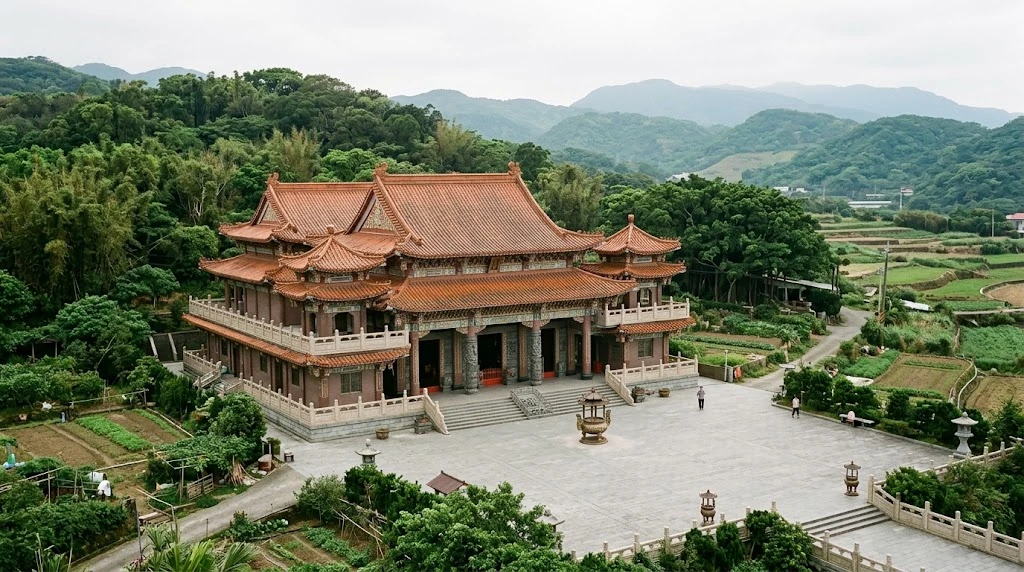
In 1895, during the Japanese invasion of Taiwan, Japanese troops set fire to Xinpu's main street, and Guanghe Temple's front hall, middle hall and statues all burned. The temple you see today was rebuilt piece by piece afterward: first a simple middle hall of mud brick in 1902, then nearly ten years of major renovation starting in 1919. Xinpu Guanghe Temple is dedicated to the Three Mountain Kings — locals also call it the Wangye Temple — a hometown faith carried here by Xinpu's Chaozhou settlers. That renovation left fine koji pottery, including a piece signed by the Quanzhou master Su Yang-shui in 1928. Xinpu is known for its old street and Hakka ancestral halls; stop by while you walk the old street.
 Illustration
Jinshan Ciyin Temple
Before an exam, some students bring a photocopy of their admission ticket and their stationery to the altar and pray to Manjushri. On exam day, they ask the temple staff to light a pineapple lamp of light for them. This is how Jinshan Ciyin Temple looks after test-takers. The temple is dedicated to Manjushri Bodhisattva (Manjusri), and according to the temple, it is the largest Manjushri place of practice in northern Taiwan. What sets it apart from most Buddhist temples is that five bodhisattvas are worshipped together: Manjushri, Ksitigarbha, Skanda (Weituo), Namo Seng and Mahasthamaprapta, whom the temple calls the Wuxian Bodhisattvas. Students come for help with their studies, but many others come to consult the bodhisattvas with divination blocks. They offer incense, state their name, birth date and address, and then ask, one question at a time, about whatever is weighing on their minds.