East Taiwan Temples
Explore representative temples in Eastern Taiwan, including main deities, history, and cultural features.

Jiaoxi Sietian Temple
Most Guan Di temples enshrine a gilded statue, but Jiaoxi Sietian Temple has a 'Silk Guan Gong', an image of Guan Sheng Di Jun built up layer upon layer from silk thread. It is one of the oldest Guan Di temples in northern Taiwan, dedicated to Guan Sheng Di Jun (Guan Gong), and one of the most important centers of faith in Yilan. On the thirteenth day of the first lunar month, the 'Turtle King' rite fills the temple with noise and crowds: worshippers ask Guan Di for a longevity turtle and return a turtle of the same kind the following year. If you want to pray to Guan Gong for your career, for justice, or for peace, this is the stop to make on your way into Yilan.

Penghu Tianhou Temple
Step into Penghu Tianhou Temple and you are standing in the oldest Mazu temple in Taiwan. It was already here before 1604, and documentary research identifies it as Taiwan's first Mazu temple, dedicated to Mazu (the Empress of Heaven). Inside is the oldest stone stele in the Taiwan-Penghu region, inscribed 'Shen Yourong Orders the Red-Haired Barbarian Weimalang and Others to Withdraw', recording how the Ming general Shen Yourong persuaded the Dutch to leave in 1604. The stele is now listed as a national treasure. In 1983 the temple was rated a first-class historic monument (today called a national monument), and its wealth of Qing-dynasty wood carving, stone carving and painted decoration survives intact. If you want to see how Taiwan's earliest temples were built, this is a living textbook.

Hualien Shen An Temple
Folk tradition holds that in 1949 (the 38th year of the Republic), the Queen Mother of the West, also called Wangmu Niangniang, Mu Niang or Yaochi Jinmu, manifested and came down to earth at Ji'an in Hualien. Hualien Shen An Temple is the birthplace of the Queen Mother faith in Taiwan. Glittering with gold and regal in style, it is dedicated to Mu Niang and holds a high place among her temples. Shen An Temple and the nearby Cihui Tang share the same origin and later divided into the Yellow-Robe and Green-Robe branches, but as the place where it all began, Shen An Temple still draws countless worshippers back to seek their roots. If you want to reach the source of Mu Niang worship, this is a Hualien stop not to skip.

Hualien City God Temple
During the Japanese colonial 'kominka' campaign, many temples across Taiwan were forced to come down, but Hualien City God Temple escaped with one clever move. The temple quietly began enshrining Koxinga (Guoxingye, whose mother, Lady Tagawa, was Japanese, so the colonial authorities saw him as having Japanese blood), and even placed Koxinga's cap on the City God, and so the temple was saved. One of the old temples of Hualien City, it is dedicated to the state-protecting City God (Chenghuang) and has watched a century of change in Hualien. Around the temple you'll find snacks like the famous temple-front black tea, part of a lively neighborhood scene, so it's a good stop whether you come to pay respects to the City God or to eat.

Yilan Sanqing Temple
Stand in front of Yilan Sanqing Temple and the whole of Meihua Lake spreads out below you. It is one of the few Taoist temples in Yilan where you can pray and look out over a lake at the same time. The temple is dedicated to the Three Pure Ones (Sanqing Daozu): Yuanshi Tianzun, Lingbao Tianzun and Daode Tianzun, and it is known as the head temple of Taoism in Taiwan. Set between the mountains and the water in quiet surroundings, Sanqing Temple is a well-known Yilan destination for both worship and sightseeing, just right if you want to pray and then take an easy walk.

Ji'an Qingxiu Yuan
Walk into Ji'an Qingxiu Yuan and for a moment you may think you are in Japan. This is the only Japanese-style Buddhist temple in Hualien and Taitung listed as cultural heritage. It began as the 'Shingon-shu Yoshino Mission' and is a Hualien County historic monument. In the Japanese era its principal image was Kobo Daishi; after the war it was rededicated to Shakyamuni Buddha and Guanyin Bodhisattva. It has a square 'hogyo-zukuri' roof, a 'Hyakudo Stone' in the courtyard for making wishes, and eighty-eight stone Buddhas modeled on the Shikoku pilgrimage sites, set out quietly one after another in the calm of a Japanese temple. If you are looking for a quiet corner of Hualien where you can slow down, this is a good fit.

Taitung Tianhou Temple
Every Lantern Festival, the streets of Taitung put on an astonishing scene: a bare-chested man stands on a palanquin while worshippers hurl strings of firecrackers at him. This is 'Bombing Master Handan', spoken of in the same breath as 'the sky lanterns of the north and the beehive fireworks of the south'. Its home is Taitung Tianhou Temple, dedicated to Mazu (the Empress of Heaven) and the only official temple in eastern Taiwan during the Qing dynasty. The temple keeps the plaque 'Numinous Aid in Pacifying the Rebels' presented by Admiral Zhang Zhaolian, and it was registered as a historic building in 2003. Each year its Lantern Festival 'procession of the gods' and Bombing Master Handan draw thousands upon thousands of people, setting the faith of the 'back mountain' region ablaze.

Matsu Tianhou Temple
Of all the Mazu temples in the world, only this one has, a few steps in front of the shrine in the main hall, the 'spirit cave' where Mazu's body is said to lie. Matsu Tianhou Temple sits beside Matsu Harbor on Nangan, facing the sea. It is the most important center of faith in the Matsu Islands and is dedicated to Mazu (the Empress of Heaven). Legend says that when Mazu's father and brother failed to come back from a fishing trip, Lin Moniang threw herself into the sea to save her father and drowned. Her body drifted to the Matsu inlet on Nangan, and the villagers, moved by her devotion to her father, buried her there and built a temple. Even the name of the Matsu Islands comes from 'Mazu': by the 20th year of the Guangxu reign, a British naval chart was already marking this island as 'Matsu'. The 'Mazu Ascension Festival' on the ninth day of the ninth lunar month is the biggest religious celebration of the year in Matsu.

Kinmen Wudao City God Temple
Every year on the twelfth day of the fourth lunar month, the whole of Kinmen turns out for a great parade, with floats and performance troupes stretching down the streets without end. This is 'Welcoming the City God in Kinmen', listed among 'Taiwan's 100 Religious Sights'. At the center of it all is Wudao City God Temple, dedicated to the City God (Chenghuang) and one of the main centers of faith in Kinmen. The temple has a three-bay, two-hall layout beneath an imposing double-eaved hip-and-gable roof. The day's festivities commemorate a piece of history: in 1680, the Kinmen garrison commander Chen Long moved the seat of government from Kinmen City to Houpu, and the City God moved with it, beginning more than three hundred years of incense in its new home.

Hualien Gang Tian Temple
Hualien Gang Tian Temple is the largest Mazu temple in Hualien and Taitung, dedicated to the goddess locals fondly call 'Gang Tian Ma' (Mazu, the Empress of Heaven), and one of the important centers of faith in Hualien City. The grounds are broad, the buildings grand and richly decorated, and the huge double-dragon staircase and the 'spider weaving its web' caisson ceiling make a strong first impression. At its anniversary celebration at the end of each year, the temple holds a grand celebration and procession that brings out the warmth of Hualien's people. If you come to Hualien to worship Mazu, this is the place not to miss.

Tafalong Ancestral Shrine
In Tafalong, in Guangfu Township, Hualien, lives an Amis community with a long history, one of the oldest and largest Amis settlements. Its ancestral shrine (kakita'an) is the heart of Tafalong's faith and of how its culture is passed down. The shrine's pillars are carved with fine wooden motifs that tell the Amis creation myths and the stories of the ancestors, a precious part of Taiwan's indigenous artistic heritage. The Harvest Festival (Ilisin) in July and August is the most important ceremony of the year: the whole community gathers to sing and dance and honor the ancestral spirits (kawas), giving thanks for their protection of the people and for the gifts of nature. The festival's songs and dances, its feasting and its strict age-grade system show the full shape of Amis society and culture.
 Illustration
Chenggong Tianhou Temple
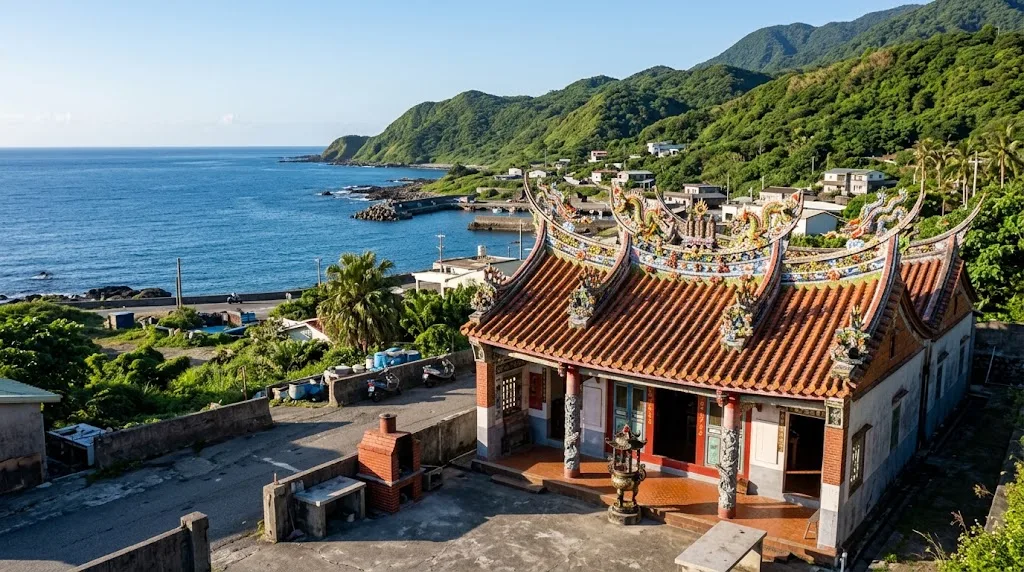
Chenggong Tianhou Temple, also called the Xiaogang Chengguang'ao Tianhou Temple, has more than 150 years of history and is the oldest Mazu temple in Taitung County. In the Qing dynasty, Liu Jin-lai was posted to the "back mountains" of the east as an interpreter-official. Before setting out, he went to Lukang's Tianhou Temple to ask Mazu to travel with him for protection; once he reached Taitung safely, he enshrined her here, and the Mazu faith took root in Taitung. The temple is also a place where peoples met: its founding at first drew opposition from local Indigenous communities, until Pingpu women mediated and the two sides learned to live side by side. On the East Coast, Chengguang'ao is a stop worth making.
 Illustration
Yuli Xietian Temple
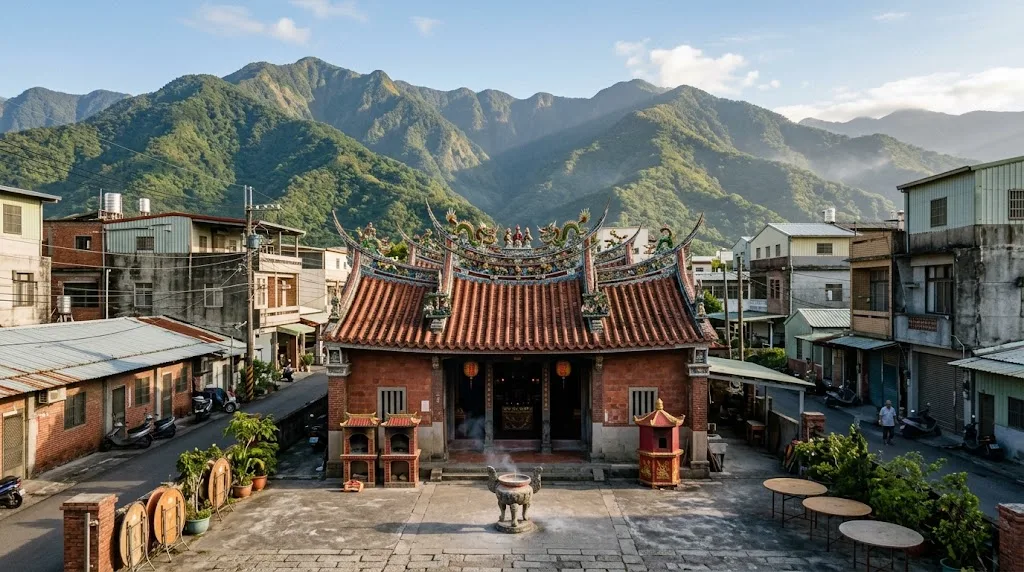
The temple's greatest treasure is a wooden plaque reading "Guardian of the Back Mountains" (後山保障) — gold regular script on black lacquer, dated the early winter of the seventh year of Guangxu, and now registered as an antiquity by Hualien County. Yuli Xietian Temple is dedicated to Guan Yu (Guansheng Dijun) and is the town's center of faith. In the Qing dynasty Yuli was called Pushige; Qing troops reached it over the Batongguan Trail, and when an epidemic struck they prayed to Guan Yu for protection — the temple grew from that prayer. If you are traveling the East Rift Valley, stop in Yuli to see this old plaque that witnessed the opening of eastern Taiwan.