South Taiwan Temples
Explore representative temples in Southern Taiwan, including main deities, history, and cultural features.

Nankunshen Daitian Temple
Almost every Wangye temple in Taiwan with a name people recognize comes back to one place to 'pay respects to the ancestor' — Nankunshen Daitian Temple in Beimen District, Tainan. It is, quite literally, the head temple of Wangye (Royal Lords) worship in Taiwan. This National Monument enshrines the Five Royal Lords — Lords Li, Chi, Wu, Zhu, and Fan — and its standing among Wangye temples could hardly be higher. The temple square is wide open, and the halls are filled with cut-porcelain mosaics, stone carving, and painting. When the pilgrimage season comes around for the Royal Lords' birthdays, processions from branch temples all over Taiwan pour back to the mother temple with drums and gongs roaring — one of the most spectacular religious sights in southern Taiwan.

Tainan Grand Mazu Temple
Tucked into the lanes of Tainan's West Central District, the Tainan Grand Mazu Temple was the first officially built Mazu temple in Taiwan — and before that, it was the palace of the Ming prince Zhu Shugui, the Prince of Ningjing. A Mazu temple converted from a royal residence: you can imagine the stature of the place. After Shi Lang's campaign against Taiwan, the palace became a Tianfei (Heavenly Consort) Temple, and it was later raised to a Tianhou (Empress of Heaven) Temple, becoming the center of Mazu worship in Qing-dynasty Taiwan. Imperial plaques from successive emperors went up one after another, and the temple is rich in historic relics. Anyone hoping for love shouldn't miss Yue Lao, the Old Man Under the Moon, in the rear hall — he is said to help a relationship warm up, and his reputation for answering prayers is known to everyone in Tainan.

Tainan Grand Martial Temple
The Tainan Grand Martial Temple (Sidian Wu Temple) is the only temple to Guan Yu in Taiwan entered into the official state rites. It stands in Tainan's West Central District, right beside the Grand Mazu Temple, and its standing is lofty. What no one forgets after a single glance is its rolling red gable wall, a full 66 meters long — a commanding sight and a must-shoot for photographers visiting Tainan. Inside, three halls follow one another in a strict, orderly plan. The main deity is the formidable Guan Sheng Dijun (Guan Gong), his eyes blazing with the bearing of the Martial Saint. Guanyin and Yue Lao are enshrined here as well — and this Yue Lao is known for severing bad romances, so people come to ask him to cut ill-fated ties clean through.

Fo Guang Shan (Buddha's Light Mountain)
From a barren hillside to more than three hundred monasteries and centers around the world — Fo Guang Shan, in Dashu District, Kaohsiung, is one of Taiwan's four great Buddhist mountains and one of its four major Buddhist organizations, founded single-handedly by Master Hsing Yun in 1967. Its best-known landmark is the Buddha Museum: along the Great Path to Buddhahood in front of it, eight pagodas stand in two rows, leading the eye to the great Buddha at the far end — a breathtaking sight. Fo Guang Shan is known for promoting 'Humanistic Buddhism,' the idea that the Dharma does not belong in remote mountains but should be woven into everyone's daily life.

Xingang Fengtian Temple
At Xingang Fengtian Temple in Xingang Township, Chiayi County, the Tiger Lord (Huye) doesn't crouch beneath the altar table — he has been invited up onto it, and that is the most distinctive thing about this Mazu temple. Fengtian Temple is known as the temple of the 'Mazu Who Opened Taiwan' (Kaitai Mazu), and it preserves many historic relics and plaques. Since 1988, the Dajia Mazu pilgrimage has made this temple the turning point of its outbound journey, turning it into a sacred destination for worshippers from all over Taiwan.

Tainan Tiantan (Altar of Heaven)
Tainan Tiantan, commonly called the 'Tiangong Temple' (Temple of the Lord of Heaven), sits in the heart of Tainan's West Central District. Built jointly by officials and the townspeople, it is dedicated to the supreme Jade Emperor (Yuhuang Dadi). Step into the plain, solemn main hall and look up: a plaque hangs there bearing a single character, 'One' (一). It is one of the 'Three Famous Plaques of the Old Capital' and was designated a general antiquity in 2009. The reasoning is wonderfully clever — the Lord of Heaven is supreme, and however many principles there may be under Heaven, none is greater than the single word 'One.' Every year on the ninth day of the first lunar month, the Jade Emperor's Birthday, worshippers lay out lavish offerings — one of the most solemn days in the old capital's calendar.

Tainan Confucius Temple
Above the East Dacheng Gate hangs a plaque reading 'Quan Tai Shou Xue' — the First School in All Taiwan. The Tainan Confucius Temple was Taiwan's first Confucian temple and the seat of the Taiwan Prefectural School in the Qing dynasty, and those four characters sum up its standing. Set in Tainan's West Central District, it follows the traditional plan of 'school on the left, temple on the right,' with grand and solemn buildings. It is not a Taoist temple, yet it carries great weight in Taiwan's folk belief and cultural heritage. Every year on September 28, Confucius' birthday, the Shidian ceremony is still held according to ancient rites, with young dancers (yisheng) performing the six-row (liuyi) dance — a stop not to be missed for anyone wanting to get close to Chinese culture and Confucian thought.

Chihkan Tower (Fort Provintia)
Chihkan Tower is not a temple — it is one of the best-known historic sites in Tainan's West Central District and a symbol of the city's spirit. It began as Fort Provintia, built by the Dutch, and today's Sea God Temple and Wenchang Pavilion stand tall on the foundations of that old Dutch fort. What makes visitors stop in the garden are the nine bixi — stone tortoise-dragons each bearing a stele — granted by the Qianlong Emperor to commemorate the suppression of the Lin Shuangwen Incident, and heavy with history. And in the Wenchang Pavilion, Kuixing holds his vermilion brush, making this historic site a place where many students also come to pray for success in their exams.

Donggang Donglong Temple
Before you even reach Donglong Temple in Donggang Township, Pingtung County, the glittering 'Golden Gateway' in front stops you in your tracks — billed as the largest golden gateway in Taiwan, it blazes in the sunlight. This renowned Wangye temple of southern Taiwan is dedicated to Lord Wen (Wen Fu Qiansui) and is the center of faith for the people of Donggang. What made it famous across the nation is the Donggang Ying Wang Ping'an Festival held every three years — popularly known as the 'burning of the royal boat' — now listed as a nationally important folk cultural asset, vast and mysterious, drawing huge crowds every time. The temple's 'jigai' ritual, in which worshippers receive a symbolic spanking, is also well known; believers trust it to change their luck and drive away misfortune.

Chiayi City God Temple
Among all of Taiwan's county-level City God temples, only one has a City God personally ennobled by an emperor: in 1875, the first year of his reign, the Guangxu Emperor conferred on the City God of Chiayi the title 'Marquis Suijing' (Suijing Hou) — a divine rank without equal. This old temple in Chiayi City's East District is thick with incense, and the building you see today was rebuilt in 1940, the fifteenth year of the Showa era. In 2015 it was upgraded to a National Monument, a witness to more than three hundred years of faith in Chiayi. The temple is rich in relics — Qing-dynasty plaques, stone steles, and wood carvings — and the City God's birthday on the second day of the eighth lunar month is one of Chiayi's grandest religious events.

Fongshan Longshan Temple
Fongshan Longshan Temple, in Fengshan District, Kaohsiung, is a Longshan temple from the Qing dynasty and is listed as a National Monument. Like many Longshan temples, it was built by immigrants from the Sanyi area of Quanzhou, with its incense brought over from the Longshan Temple in Jinjiang, Quanzhou. The main deity is Guanyin (Guanshiyin Bodhisattva), and the temple's cut-porcelain mosaics and clay sculptures are especially fine — masterful in technique and well preserved, they are what those in the know come here specifically to see. Amid its simple, solemn atmosphere, this temple, one of the four great old temples of Fengshan, has quietly witnessed the rise and fall of the old town of Fengshan, and it remains an important resource for studying Taiwan's traditional architecture and folk belief.

Checheng Fu'an Temple
Place gold paper at the mouth of the furnace and it is drawn in, sheet after sheet, all on its own — the 'divine cash-counting machine' furnace at Fu'an Temple in Checheng Township, Pingtung County, relies on a precisely designed air convection that leaves worshippers marveling. Checheng Fu'an Temple bills itself as the largest Earth God (Tudi Gong) temple in Taiwan, and its incense burns thick. The main deity, Fude Zhengshen (the Earth God), wears a dragon robe and an official's cap — nothing like the plain Earth God figures seen elsewhere — and legend says this is because he was honored by the Qianlong Emperor. The temple is grand and imposing, and it is the stop most worth making on the drive south toward Kenting.

Pingtung Jiuru Sanshan Guowang Temple
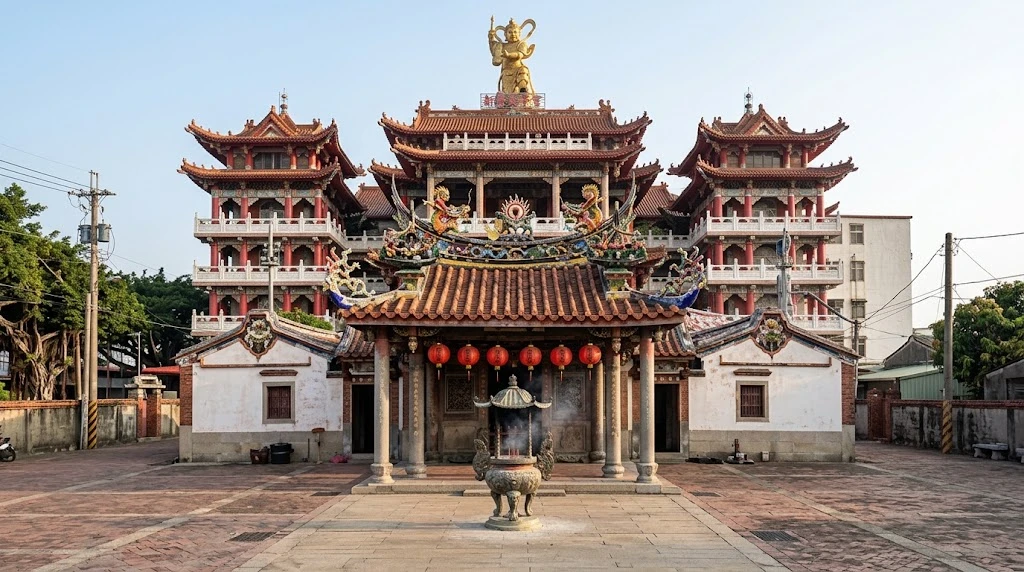
Pingtung Jiuru Sanshan Guowang Temple, built in 1778 (the 43rd year of the Qianlong reign), is a Pingtung County historic site dedicated to the three Kings of Jinshan, Mingshan and Dushan. The "Wei Zhen Hai Dong" plaque hanging high in the main hall is dated to the year the temple was built; the worship pavilion is painted with the Hetu and Luoshu diagrams, the door gods are the work of the painter Pan Li-shui, and the wood carvings on the front facade draw on Romance of the Three Kingdoms and Romance of Sui and Tang. Worship here crosses ethnic lines: the temple's most famous legend involves the Hakka of neighboring Linluo, and the Hoklo who later settled in Jiuru carried on the worship.
 Illustration
Xinying Taizi Temple
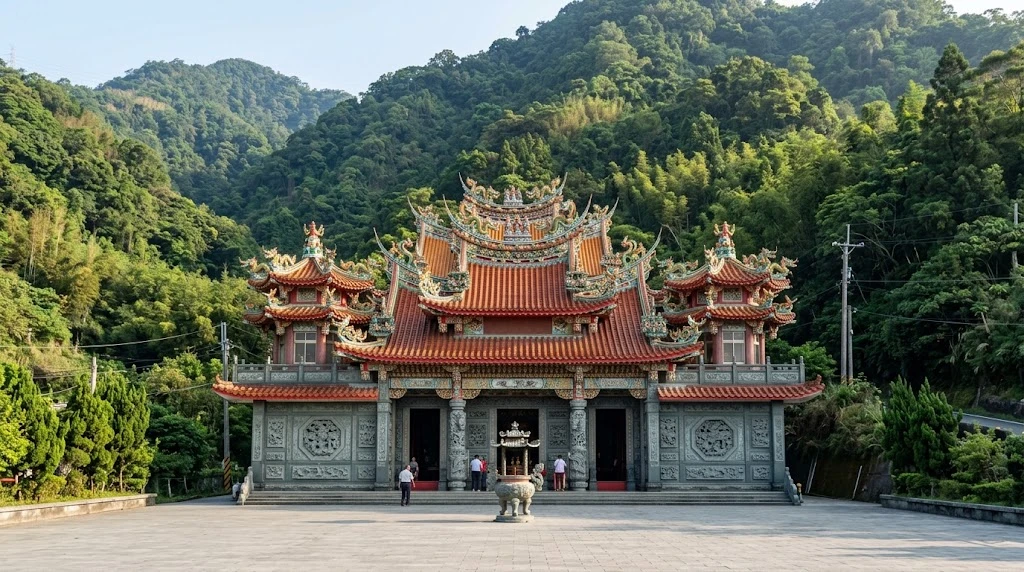
Xinying Taizi Temple is regarded as the founding mother temple of Marshal Zhongtan — the Third Prince, Nezha — with branch temples spread far and wide that return each year to pay respects to their ancestor. The grandest day comes in the ninth lunar month: around the Third Prince's birthday, sedan chairs from branch temples everywhere arrive one after another to gather incense in Xinying, and the roads overflow with procession troupes. The temple grounds hold two temples, old and new. The old temple is listed as a Tainan City historic site — small in scale, but it is where the roots lie — while the new temple takes in the pilgrim crowds from all over. To see Third Prince worship in its most original form, step into the old temple first: that is where all this celebration began.
 Illustration
Chukou Longyin Temple
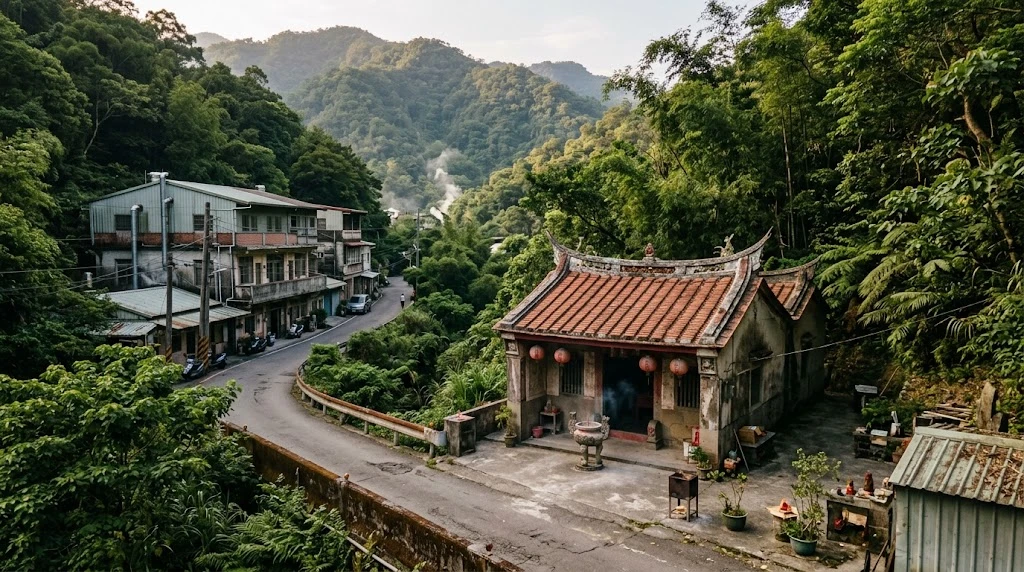
Ji Gong, with his tattered hat, tattered fan and ragged robe, was once filmed at this very temple. According to the temple, both TTV's drama series Ji Gong and CTV's drama series Ji Gong the Living Buddha chose Chukou Longyin Temple in Fanlu, Chiayi, as a filming location. Longyin Temple is dedicated to Chan Master Ji Gong, the much-loved Living Buddha Ji Gong. It sits at the foot of Chukou Mountain on the way toward Alishan, within the Alishan National Scenic Area. The large stone panels on either side of the main entrance are carved with scenes of Ji Gong guiding people toward salvation, and the eaves are covered with auspicious dragons in cut-porcelain mosaic. The Yuantong Hall on the second floor enshrines Guanyin Bodhisattva, flanked by Manjushri and Samantabhadra. The temple has set lunar 10/3 as the day Chan Master Ji Gong attained the Way, and each year a birthday ceremony is held that morning during the chen hour. It is the liveliest day of the year.
 Illustration
Guanziling Huowangye Temple
On the opening night of the autumn Guanziling Hot Spring Food Festival, an illuminated Acala float sets out from the Baoquan Bridge parking lot and is pulled up the mountain road to Dacheng Hall Plaza, with people in yukata carrying lanterns in the procession. The deity being carried out is the main god of Guanziling Huowangye Temple. Huowangye, the Fire King, is Acala (Fudo Myoo). In the early years of Japanese rule, when the hot springs were being developed, the Japanese set up an image of Acala above the spring source to pray for safety. Later the statue and its stone tablet were taken away, so local residents pooled money to build a temple, recreated the statue after the original, and gave it a name that came more naturally to Taiwanese tongues. The temple is small, yet it is the center of faith for Guanziling's hot spring businesses and residents. Each year the hot spring operators choose an incense master (luzhu) by divination to lead the offerings, praying that the springs never run dry. Before you soak, stop by to meet the guardian of these mud hot springs.